

Frein à pression CNC de 4000 mm: Quand la longueur supplémentaire porte ses fruits
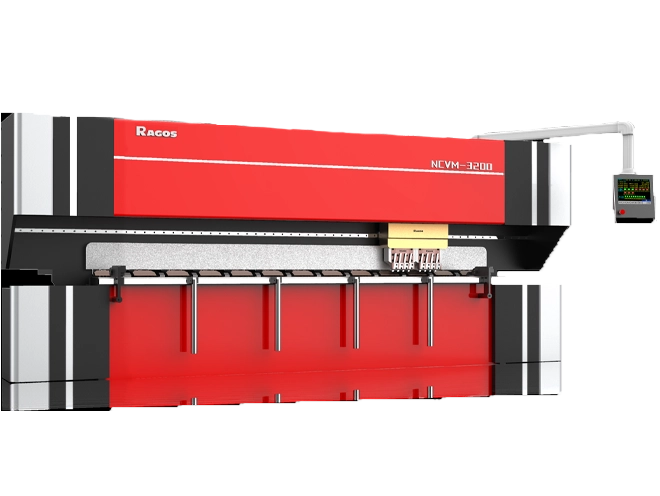
Les plateaux standards de 2500 mm ou 3200 mm atteignent souvent leurs limites physiques face à la demande moderne de lits sans couture, Composants industriels à grande échelle. Un frein à pression CNC de 4000 mm existe pour éliminer le "Piège de repositionnement"— le processus coûteux et imprécis de pliage de longues pièces en plusieurs étapes. Lorsque la production implique des panneaux dépassant la longueur standard de 10 pieds, L’envergure supplémentaire devient une nécessité à gérer Risque de grande travée non supportée.
Les machines plus courtes forcent souvent les fabricants à prendre des décisions difficiles qui compromettent Défi d’uniformité des longues courbures de bord ou en résultent Gestion de la compensation du flassement des panneaux. Ce guide explique comment le passage à une plateforme de 4 mètres permet Stabilité de positionnement à blanc étendue Nécessaire pour devenir complexe, des designs au format long dans une réalité de haute précision.
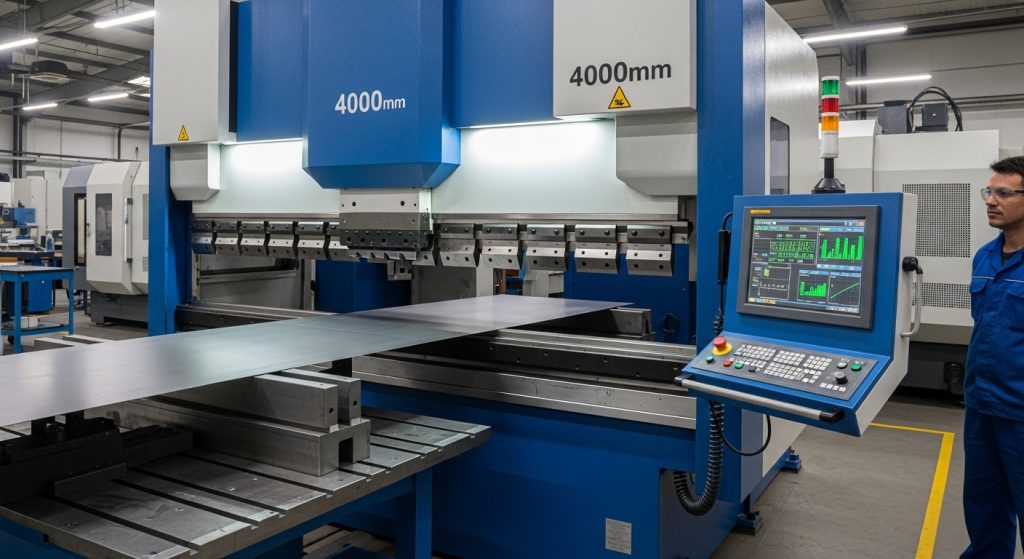
Vous devriez envisager une mise à niveau quand:
- Vous pliez des panneaux architecturaux ou des peaux de véhicules plus longs que 3100 mm.
- Votre actuel "Double flexion" Le procédé crée un taux de ferraille de 15 % ou plus à cause d’erreurs d’alignement.
- La fatigue de l’opérateur et les risques pour la sécurité augmentent en raison de la manipulation manuelle des plaques en surplomb.
- Il faut faire fonctionner plusieurs configurations d’outillages simultanément pour finir une pièce en une seule passe.
Où les machines à freinage à pression CNC de 4000 mm éliminent le risque de formage de panneaux longs
Plier une feuille de 4 mètres sur une machine avec un lit plus court crée un "Enveloppe de stabilité de zone formant" Problème. Lorsque le matériau s’étend bien au-delà des cadres latéraux, Le poids du surplomb crée un Dérive de courbure vide induite par la gravité, ce qui entraîne des angles imprécis et des tordes physiques dans le métal.
- Instabilité des panneaux longs: Un plateau de 4000 mm fournit un Canal de transfert de charge structurel qui soutient le matériau sur toute sa longueur, empêchant les extrémités de "battements d’ailes" Pendant l’AVC.
- Repositionnement des risques: Utiliser une machine de 3200 mm pour une pièce de 4 000 mm nécessite deux coups. Cela introduit un Erreur de référencement multi-configuration, où la seconde courbure s’aligne rarement parfaitement avec la première.
- Avantages de la portée totale: Avec 4 mètres de soutien, Tu y arrives Suppression de la distorsion par onde de bord, s’assurant que la bride reste droite d’une extrémité à l’autre sans "Mise en conserve à l’huile" Effets.
Scénarios d’usine réels qui poussent les ateliers à atteindre une longueur de frein à pression CNC de 4000 mm
La décision d’investir dans une machine de 4 mètres est généralement motivée par des contrats spécifiques à forte valeur ajoutée que les petites machines ne peuvent tout simplement pas exécuter de manière sûre ou rentable.
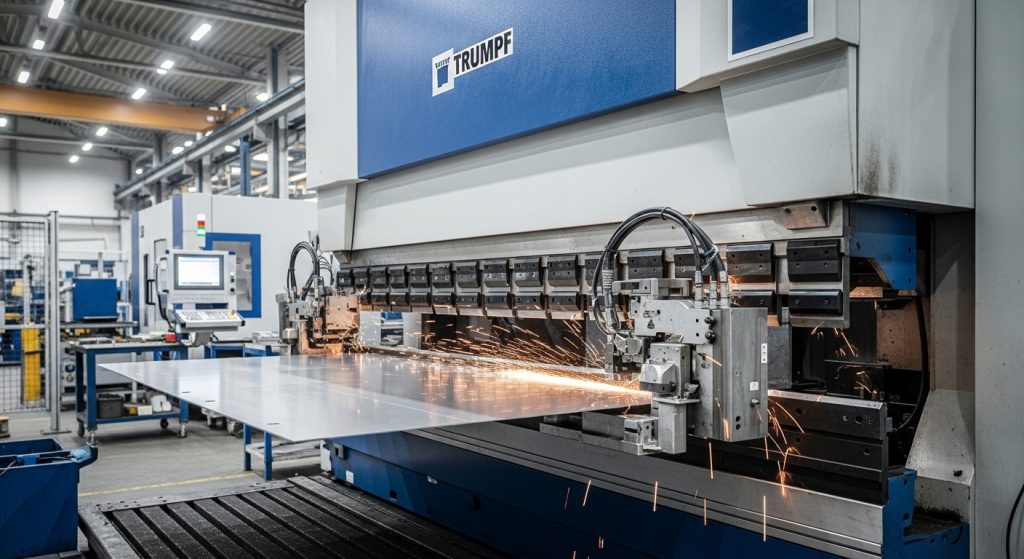
- Formation de la peau latérale du véhicule: La fabrication moderne de bus et de remorques nécessite des panneaux latéraux allant jusqu’à 4 mètres pour minimiser les joints, ce qui améliore l’aérodynamique et l’intégrité structurelle.
- Courbure de coquille d’armoire industrielle: Les salles de contrôle électrique à grande échelle et les enceintes de centres de données utilisent souvent des portées verticales de 4 mètres pour réduire le temps d’assemblage.
- Fabrication de coques métalliques d’infrastructure: Les composants de pont et les poteaux d’éclairage nécessitent un Intégration d’assemblages de panneaux lourds que seul un long lit peut offrir.
- Fabrication de grandes sections de conduits: Les systèmes CVC à fort volume pour les stades ou usines utilisent des sections de 4000 mm pour minimiser le nombre de joints, Réduction des fuites d’air et de la main-d’œuvre d’installation.
Exécuter ces tâches sur une machine de 4000 mm garantit un Équilibre de formation de panneaux longs qui protège à la fois le matériau et l’opérateur du comportement imprévisible du métal en surplomb.
Le coût caché de faire circuler des pièces longues sur des plateaux de frein à pression plus courts
De nombreux ateliers estiment économiser de l’argent en restant sur des machines de 3200 mm, mais le fonctionnement "Friction" la manipulation de pièces longues sur des plateaux courts crée un décharge important sur les résultats financiers.
| Facteur de coût | Frein à planche à plateau court | Frein à pression CNC de 4000 mm |
| Repositionnement du travail | Haut (2-3 opérateurs nécessaires) | Minimal (1 opérateur soutient) |
| Précision de flexion | Variable (Déviation de répétabilité en flexion) | Étable (Stabilité linéaire du mouvement RAM) |
| Charge d’outil | Concentré (Point chaud de pression de l’outil) | Répartition égale (Propagation linéaire de la charge) |
| Taux de ferraille | Plus élevé en raison de la dérive d’alignement | Extrêmement bas |
Tentative de "Triche" la longueur d’une machine donne un Pénalité de temps de repositionnement de l’opérateur Cela peut doubler le temps de production par pièce. De plus,, La pression concentrée sur un dispositif d’outillages courts augmente le risque de Formation de points chauds à pression d’outil, ce qui entraîne une défaillance prématurée de l’outil et une usure inégale du bélier de la machine.
Comment la longueur supplémentaire du lit modifie la répartition réelle du tonnage
Dans une machine de 4000 mm, La Force ne se limite pas au total des tonnes; il s’agit de la Champ de pression de déformation distribué. Concevoir un courbure de 4 mètres nécessite de comprendre le Chemin de flux de contrainte dans le cadre de la machine à éviter "Pointe centrale" ou "Canoë" Effets dans la partie finale.
Le tonnage requis pour une courbure de 4000 mm peut être estimé en utilisant la formule simplifiée de la flexion de l’air:
$$P = frac{1.42 cdot sigma_b cdot S^2 cdot L}{V cdot 1000}$$
- $P$ = Pression (Des tonnes)
- $sigma_b$ = Résistance à la traction du matériau ($N/mm^2$)
- $S$ = Épaisseur du matériau ($mm$)
- $L$ = Longueur de courbure (4000 mm$ $)
- $V$ = ouverture du dé V ($mm$)
- Propagation linéaire de la charge: À mesure que $L$ augmente à 4000 mm, la pression totale $P$ s’étale de façon linéaire, nécessitant un système hydraulique plus robuste pour être maintenu Stabilité linéaire du mouvement RAM.
- Équilibrage à toute portée: Le CNC doit calculer un Motif de compensation de déviation du bélier (Couronnement) c’est nettement plus agressif que sur une machine de 2 mètres.
- Écoulement de contrainte du cadre: Les boîtiers latéraux doivent être suffisamment espacés pour permettre un Contrôle de l’axe neutre de la longue feuille, S’assurer que le cadre ne le fasse pas "Lacet" sous des charges asymétriques.
Stratégies de disposition des outillages uniquement possibles sur les machines à frein à pression CNC 4000 mm
L’immense espace de travail de 4 mètres permet une complexité Continuité linéaire de l’interface de l’outil C’est impossible sur les petits plates-bandes.
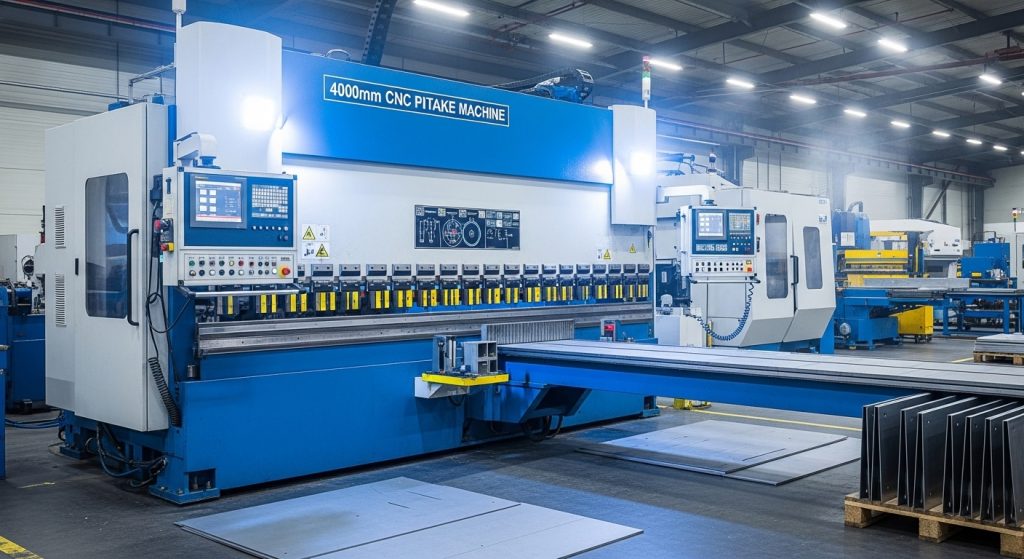
- Configurations à plusieurs étages: Vous pouvez mettre en place un "Grossoiage" le, a "Finition" le, et un "Ourlement" Die tous sur le même plateau de 4000 mm. Cela permet à l’opérateur de finir une pièce complexe sans jamais arrêter la machine pour changer d’outil.
- Comportement de placement Long Die: Un plateau de 4000 mm fournit un Uniformité de la surface d’assise des matrices Cela garantit que l’outillage reste parfaitement plat, même en pliant des plaques épaisses.
- Alignement du poinçon: Le rail de distribution de charge à pince Sur une machine de 4 mètres, elle est conçue pour être maintenue Suivi de course verticale du poinçon, empêchant le "Échancher" Cela peut arriver lorsque plusieurs segments d’outillage sont assemblés sur une longue distance.
Pourquoi les panneaux longs perdent-ils en précision géométrique sans support complet du plateau
Quand un blank en tôle s’affaisse sous son propre poids, le "Angle d’entrée" Changements dans le dé. Cela crée un Dérive de courbure vide induite par la gravité que le contrôleur CNC ne peut pas toujours compenser si le matériau n’est pas entièrement supporté.
- Effet Sagitation: Sans le Géométrie du lit de formage étendu, Le centre de la feuille s’abaisse, tirant les bords vers l’intérieur et provoquant un Gradient de perte de cohérence d’angle.
- Décalage de retour à ressort: En longues parties, le Ligne de déviation de récupération à ressort n’est pas uniforme. Les extrémités de la pièce ressortent souvent différemment du centre en raison de l’absence de support latéral pendant le coup.
- Formant la répétabilité: Réalisation Formation à envergure complète avec précision répétée nécessite que le matériau soit parfaitement plat contre les jauges de fond. Sur une machine de 4000 mm, doigts à double calibre arrière (souvent 4 à 6) Assurez-vous que le long bord est parfaitement parallèle à la ligne de courbure.
Le débit de production augmente lorsque les étapes de repositionnement disparaissent
Le ROI principal d’une machine de 4 mètres est le Compression en temps de Takt de production. En éliminant la nécessité d’arrêter, Bouge, et réaligner une pièce, Le déroulement de l’atelier change fondamentalement.
Avant (Machine 3200mm):
- Étape 1: Plie le côté gauche du panneau de 4 m.
- Étape 2: Deux opérateurs font pivoter et coulisser manuellement le panneau lourd.
- Étape 3: Réaligner avec les écartements en retard (cela prend souvent 2 à 3 minutes).
- Étape 4: Plie le côté droit et espère que la couture du milieu s’aligne.
Après (Machine 4000mm):
- Séquence de formation à passage unique: Chargez la feuille de 4 mètres une fois.
- Élimination des interruptions de préparation: Un coup, une partie parfaite.
- Indice de continuité du débit par lots: Haut; la machine maintient un rythme régulier sans le "du désordre" de pièces à moitié terminées en attente d’être repositionnées.
Quand un frein à pression CNC de 4000 mm est un mauvais choix financier
Malgré les avantages, Le quai de 4 mètres n’est pas fait pour tous les magasins. Vous devez évaluer votre Contrainte d’allocation spatiale des installations et répartition des emplois.
- Opérations à faible volume: Si votre "Longue partie" Les contrats n’apparaissent qu’une fois par mois, le Exposition à l’utilisation de la machine au repos peut ne pas justifier le coût d’investissement plus élevé.
- Production de courts rôles: Si 95 % de votre travail est en dessous de 2 mètres, Une machine de 4000 mm est inefficace. La RAM plus grande est plus lente à cycler et consomme plus d’énergie par course.
- Restrictions d’espace: Une machine de 4000 mm nécessite souvent une fondation spécialisée et beaucoup plus d’espace au sol pour la manutention des matériaux, Augmentation de la Fenêtre de risque de retard de récupération de capital.
Comment calculer le retour sur investissement avant d’acheter un frein à pression CNC de 4000 mm
Pour justifier l’investissement, Utiliser un Coefficient de réduction de la manipulation de la main-d’œuvre. Si une pièce de 4 mètres prend 15 minutes sur un lit court (avec 2 personnes) et 4 minutes sur un long lit (avec 1 personne), Les économies sont énormes.
- Gain de sortie: Calculer le Sortie par multiplicateur d’expansion de décalage. La plupart des ateliers constatent une augmentation de 30 à 40 % du débit pour les pièces longues.
- Économies de main-d’œuvre: Estimer la réduction des heures de travail. En partant d’un "Télésiège à deux personnes" à un "Diapositive solo" Réduit considérablement les coûts.
- Expansion des emplois: Utilisation Levier d’acquisition de contrats en grande partie pour soumissionner sur des emplois dans les infrastructures ou le transport qui étaient auparavant "sans guillemets" Objets.
Exemple: Si une machine de 4000 mm économise 15 $ de main-d’œuvre/ferraille par panneau et que vous faites tourner 20 panneaux par jour, les 7 $,200 d’économies annuelles n’est qu’un début; La vraie valeur, c’est les 200 000 $+ de nouveaux contrats que vous pouvez désormais remplir.
Lorsqu’ils sont en position montée, les freins à pression améliorent la maniabilité des grandes pièces
Pour des pièces extrêmement grandes ou lourdes, un Frein de presse montant peut changer la donne. Parce que la poutre inférieure monte, La gravité aide en fait à maintenir la plaque à plat contre la matrice, Réduire le besoin de suiveurs de feuilles complexes. Cette configuration est souvent préférée dans les applications de 4 mètres et plus longues où la sécurité de l’opérateur et le positionnement des matériaux sont les priorités principales.
Quand le frein à pression CNC de 3200 mm reste le choix le plus intelligent
Si votre installation manque d’espace ou si votre production se concentre sur une plage de 2,5 à 2,5 mètres, a Frein à pression CNC de 3200 mm reste la plus polyvalente "Un polyvalent." Il offre une vitesse de cycle plus rapide pour les pièces courtes tout en offrant suffisamment de longueur pour les feuilles industrielles standard, ce qui en fait le meilleur choix pour les magasins à forte concentration, profil à faible volume.
Lorsque l’acier inoxydable est utilisé, les longues pièces nécessitent une focalisation plus élevée sur la force de formage.
Plier 4 mètres d’acier inoxydable nécessite une augmentation massive de tonnage en raison de la haute résistance à la traction du matériau. Dans ces cas, a Frein à pression CNC 200T c’est souvent le minimum pour éviter que la machine ne calle en plein détour. Un calcul précis du tonnage est essentiel ici pour éviter que la déviation du cadre ne dépasse la capacité du système de couronnement à compenser.
Lorsque la fabrication de plaques lourdes nécessite des machines de 600 à 3000 T
Quand vos pièces de 4 mètres bougent de "Feuilles" à "Plaques" (12 mm et plus), vous entrez dans le territoire de Freins à pression hydrauliques lourds. Ces géants de 600 à 3000 tonnes sont construits avec des profondeurs de gorge massives et des châssis renforcés pour supporter les contraintes extrêmes de la construction navale, Fabrication de grues, et infrastructures lourdes.
Frein à pression CNC de 3200 mm vs 4000 mm: Le point de rupture de mise à niveau
Choisir la bonne longueur est un équilibre entre les besoins actuels et la prévision de l’avenir. Notre Comparaison 3200mm vs 4000mm décompose les différences techniques spécifiques dans le déplacement de l’écartement de fond, Rigidité du châssis, et la logistique du transport pour vous aider à décider