


Press Brake Tonnage Calculator: How to Choose Die Opening
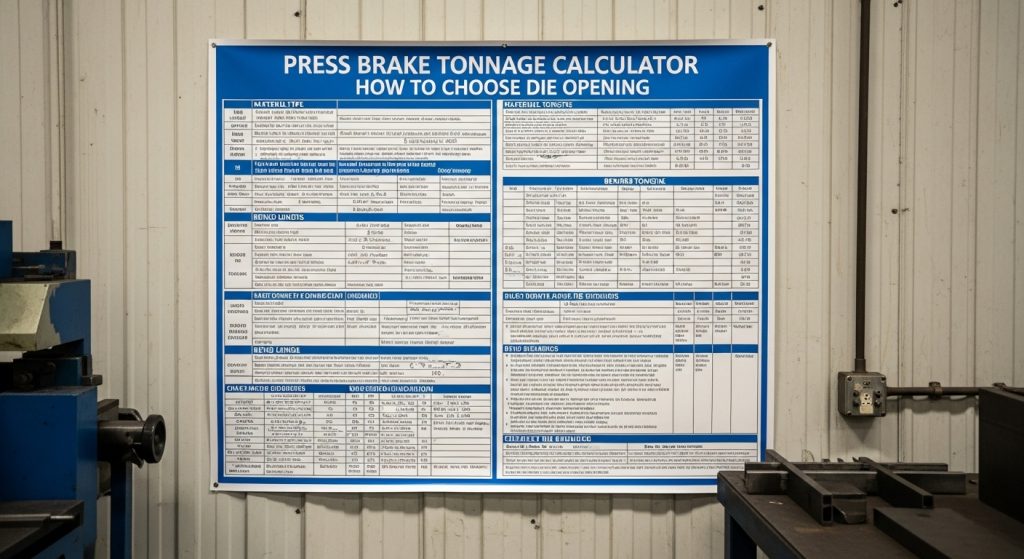
Stop risking your tooling on guesswork. Whether you are using a manual setup or a high-end CNC system, understanding how to balance tonnage and die selection is vital for safe and precise fabrication. This guide breaks down the industry-standard formulas to help you choose the right V-opening every time.
What Does a Press Brake Tonnage Calculator Do?
A press brake tonnage calculator determines the force required to bend a specific thickness of metal over a specific die opening. It ensures your machine has the necessary press brake capacity to complete the job without overloading the hydraulic system or snapping a punch.
Without an accurate calculation, you are operating in the dark. If you underestimate the force, the ram may stall mid-bend, leaving you with a ruined part and a potentially jammed machine. If you overestimate, you might choose a die that is unnecessarily wide, resulting in a sloppy radius that doesn't meet the design specifications.
The Basic Industry Formula for Air Bending
For standard mild steel, most shops use a simplified "rule of thumb" to estimate the force needed. While complex engineering software exists, this quick calculation is incredibly reliable for daily floor operations:
Tonnage per meter ≈ Thickness² × 1.4
If you are working with 10mm steel, the math looks like this:$10 \times 10 \times 1.4 = 140\text{ tons per meter}$.
This 1.4 coefficient is a shortcut based on a standard 8x V-opening. It provides a baseline that covers most air-bending scenarios. However, the moment you change your die opening or your material type, this number must be adjusted to maintain safety and accuracy.
Material Adjustments for Precision
Not all metals respond to pressure the same way. The base formula assumes mild steel with a tensile strength of approximately $450\text{ N/mm}^2$. You must adjust your results if you switch to stainless or aluminum.
| Material | Force Change | Adjustment Factor |
| Mild Steel | Base Value | 1.0 |
| Stainless Steel | +40% to +60% | 1.4 – 1.6 |
| Aluminum | −40% to −50% | 0.5 – 0.6 |
If that same 10mm project uses stainless steel, your required tonnage could spike to over 200 tons per meter. This is why checking your die opening tonnage limits before you start is non-negotiable. Stainless steel has a much higher "work hardening" rate, meaning it fights back harder as the bend progresses. Aluminum, conversely, is much softer but prone to cracking if the die opening is too narrow.
How to Choose the Right Die Opening (V-Die Selection)
Choosing your die opening is a balancing act between the force your machine can provide and the bend radius your part requires. The wider the opening, the lower the tonnage needed, but the larger the inside radius of the bend will be.
The Standard Rule: 6x to 10x Thickness
For the vast majority of air bending applications, you should select a V-opening that is between 6 and 10 times the thickness of your material ($V = 6 \text{ to } 10 \times S$).
- 6x Thickness: This is a "Tight Bend" scenario. It requires significant force and is usually reserved for thinner materials where a small radius is critical for the final assembly.
- 8x Thickness: This is the "Industry Sweet Spot." It provides the most predictable results, standard springback, and a balanced load on the machine.
- 10x to 12x Thickness: This is for "Heavy Duty" or "High Capacity" bending. By opening the die wider, you significantly reduce the tonnage, which is often necessary when working with a 4000mm press brake on full-length thick plates.
Example for 10mm Steel Bending
When performing 10mm sheet bending, your choice of die will drastically change the machine's behavior:
- 60mm V-Opening (6x): This results in a tight bend but requires nearly 150 tons per meter. It puts extreme stress on the punch tip and the die shoulders.
- 80mm V-Opening (8x): This is the ideal setup. It requires roughly 82-100 tons per meter, providing a stable, repeatable 90-degree bend with manageable wear.
- 100mm V-Opening (10x): This creates a larger radius and is much safer if your machine is nearing its maximum limit. It drops the tonnage requirement by nearly 20%.
Why the Die Opening Size Matters for Your Machine
The V-die opening acts as the "leverage" point of the bend. Just as a longer wrench makes it easier to turn a stiff bolt, a wider die opening makes it easier for the press brake to deform the steel.
Effects of a Smaller V-Die
When you force metal into a narrow V-opening, the "leverage" is low. This results in:
- Higher Tonnage Required: The machine has to push with massive force to overcome the material's resistance over a short span.
- Tighter Inside Radius: This is often requested by engineers who want a sharp look, but it comes at a mechanical cost.
- Increased Tool Wear: The friction on the die shoulders is much higher. Over time, this causes "galling" or grooves in your dies, which will eventually mark every part you bend.
Effects of a Larger V-Die
Widening the opening increases your leverage, leading to:
- Lower Tonnage Required: This protects your heavy duty press brake from premature hydraulic fatigue and frame deflection.
- Larger Bend Radius: Because the material has more room to curve naturally, the inner radius increases ($Ri \approx 0.156 \times V$).
- Safer for Thick Plate: It reduces the likelihood of "stress cracks" on the outer surface of the bend, which is common when bending thick, high-carbon steel.
The Relationship Between Inner Radius and Springback
One of the most overlooked aspects of die selection is how it influences springback. Springback occurs when the metal tries to return to its original shape after the punch releases pressure.
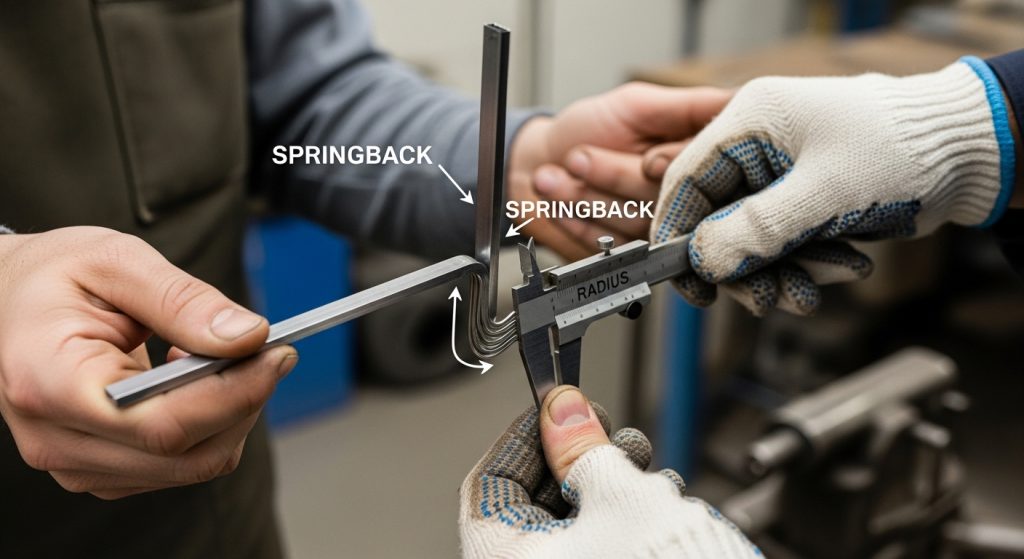
In a narrow die (6x), the material is stretched more aggressively, which can actually reduce the percentage of springback but increases the risk of fracture. In a wider die (10x-12x), the material is "formed" more gently, which often leads to more predictable springback. For 10mm steel, you might expect 1 to 2 degrees of springback. If you use a die that is too large for the thickness, the material may not even reach its yield point effectively, making it nearly impossible to hit a consistent 90-degree angle.
Machine Deflection and the "Crowning" Factor
When you bend heavy 10mm plate over long distances, such as 3 or 4 meters, the machine itself flexes. The center of the ram and the bed will slightly bow apart under 200+ tons of pressure.
Choosing a wider die opening helps mitigate this deflection by lowering the total tonnage. However, for precision work, you must use a crowning system. Whether it is a hydraulic system built into the 4000mm press brake or a manual wedge system, crowning ensures that the middle of your 10mm plate is just as crisp as the ends.
Setup Checklist for Heavy Plate Bending
Before you hit the foot pedal on a high-tonnage job, run through this verification list:
- Material Identification: Is this mild steel, or is it a high-tensile alloy? Check the mill certificate if available.
- Die Integrity: Are the shoulders of the V-die smooth and lubricated? Heavy plate can "seize" on a dry die, spiking the tonnage unexpectedly.
- Punch Radius: Ensure your punch radius is appropriate for the thickness. Using a "knife" punch on 10mm steel will result in a "sharp" bend that is structurally weak.
- Backgauge Calibration: High-tonnage bends can create "vibration shock" that may shift backgauge fingers. Ensure they are locked tight.
- Safety Clearance: Make sure the "whip-up" area is clear. A 3-meter sheet of 10mm steel moving upward at 10mm/s carries immense momentum.
Troubleshooting Tonnage Spikes
If your machine is struggling to complete a bend that the calculator said was possible, consider these three "hidden" factors:
- Cold Material: Steel that has been stored in a freezing warehouse is harder to bend than steel at room temperature. Cold increases the yield strength of the metal.
- Grain Direction: If you are bending "with the grain" (parallel to the rolling direction), the steel is easier to bend but prone to cracking. Bending "against the grain" requires about 10% more tonnage but is much stronger.
- Tooling Friction: If your V-die is rusty or dirty, the friction between the plate and the die shoulders can add up to 15% to your total tonnage requirement.
Simple Shop Floor Method for Daily Success
Follow these three steps for every new setup:
Step 1: Pick Your V-Die Start with the "8x rule." For 10mm steel, reach for an 80mm V-die. This provides a clean bend with manageable pressure.
Step 2: Calculate Your Tonnage Use the formula or a digital calculator to see if your machine can handle the load. Multiply the "tons per meter" by the total length of your part. If you have a 3-meter part at 82 tons/meter, you need at least 246 tons of force.
Step 3: Check Your Margin Never run your machine at 100% capacity. Always add a 20% safety margin. If your part requires 246 tons, you should be using a machine rated for at least 300 tons.
By mastering the relationship between tonnage and die opening, you extend the life of your equipment and produce parts that meet engineering specs every time.
Frequently Asked Questions
What happens if I use a V-die that is too small?
Using a die that is too small (less than 6x thickness) drastically increases the required tonnage. This creates extreme pressure on the punch and die, which can lead to tool breakage. It also causes the material to "dig" into the die shoulders, leaving deep marks and potentially cracking the outer radius of the bend.
Does a larger V-opening make the bend more accurate?
A larger V-opening (10x to 12x thickness) reduces tonnage and makes the process safer for the machine, but it also increases the inner bend radius. While this can prevent cracking in thick plates, it may result in more springback. Accuracy comes from finding the "sweet spot"—usually 8x the thickness—where force and radius are perfectly balanced.
How does stainless steel change the die selection process?
Stainless steel has a higher tensile strength and work-hardens quickly. Because it requires roughly 50% more pressure than mild steel, you should often choose a slightly wider V-die (10x thickness) to keep the tonnage within safe limits for your heavy duty press brake.
Can I calculate tonnage for multiple bends at once?
Tonnage is calculated per bend. If you are performing multiple bends simultaneously (using a specialized tool or a long bed), you must add the required tonnage for each individual section together. Always ensure the total sum remains at least 20% below the machine's maximum rated capacity.
Why does my 10mm steel crack even when using the correct tonnage?
Cracking is usually a result of bending "with the grain" or using a punch with a radius that is too sharp. For 10mm sheet bending, try to bend perpendicular to the rolling grain and use a punch with a radius of at least 3mm to 5mm to distribute the stress more evenly.