





Résistance à l’élasticité du métal : ce que cela signifie et pourquoi il est important dans la fabrication
Lorsqu’on parle de fabrication métallique, la résistance est souvent considérée comme un terme général, mais la résistance peut être comprise de différentes manières, selon la manière dont un matériau est chargé et la manière dont il sera façonné. Lorsque vous effectuez une opération de flexion, que vous mettez en place des programmes de freins à pression ou que vous spécifiez des matériaux sur des pièces qui doivent résister à des charges de service réelles, la résistance à l’élasticité est l’une des valeurs de matériau les plus pratiques que vous puissiez apprendre. Il vous informe de la quantité de contrainte qu’un certain métal pourra supporter avant de commencer à se déformer de façon permanente — et lorsque vous atteignez ce point, la pièce ne reprendra plus sa forme d’origine.
Chez JSRAGOS intelligent equipment, nous traitons avec des fabricants sur le marché mondial qui exigent des performances de flexion constantes sur l’acier doux et l’inoxydable jusqu’aux matériaux alliés plus résistants. Ce tutoriel décrit la limite d’élasticité en termes simples, illustre la relation entre la résistance à l’élasticité et la résistance à la traction, et souligne l’influence de la première sur le processus de flexion, de roulement et de réussite dans la formation en général.
Résistance vs Dureté : Ne confondez pas les deux
Une confusion courante est de supposer que « dur » signifie « fort ». La dureté décrit la résistance d’un matériau à l’incosion ou à l’usure de la surface, tandis que la résistance décrit le comportement du matériau sous charge — en particulier la tension et la flexion. Un métal peut être très dur mais aussi sujet à se fissurer s’il manque de ductilité, ce qui est important quand on le met sur un frein à pression.
Qu’est-ce que la limite d’élasticité ?
Limite d’élasticité est le niveau de contrainte auquel un métal transite depuis Élastique comportement à plastique comportement. En dessous du claquant, le métal se comporte comme un ressort : enlever la force, et il revient (en grande partie) à sa forme d’origine. Au-dessus de la limite d’élasticité, le métal « cède » et un changement permanent subsiste après la suppression de la force.
C’est précisément pour cela que la résistance à l’élasticité est si importante dans le formage : la flexion nécessite de pousser le matériau Passé le point de cédent pour garder le nouvel angle, mais il faut éviter de pousser trop loin vers la panne.
Déformation élastique vs plastique : l’histoire contrainte-déformation
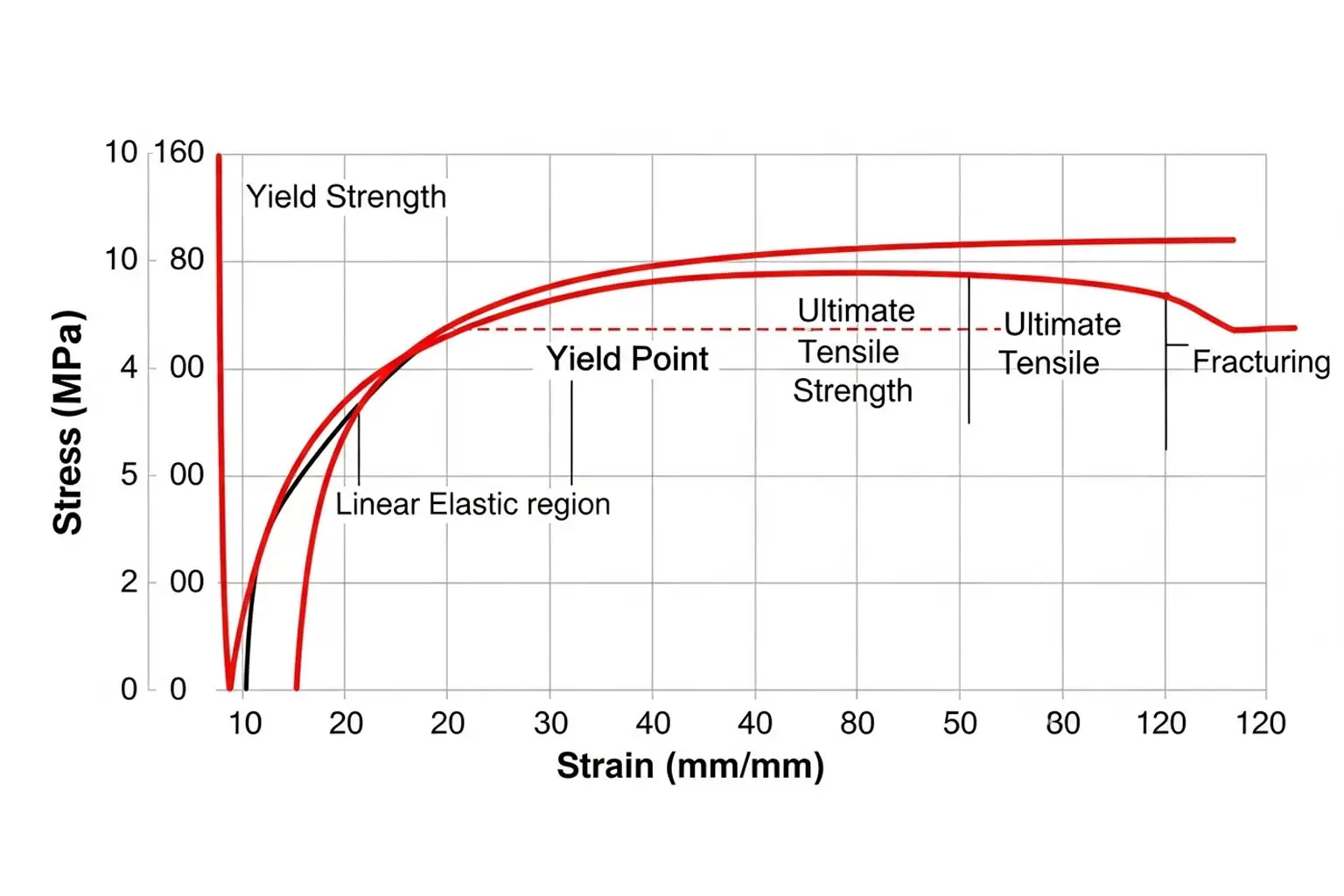
Les métaux répondent à la force par une relation entre Contrainte (force par zone) et Contrainte (déformation). Au début, la relation est principalement linéaire — la contrainte augmente et le matériau s’étire ou se comprime proportionnellement. Cette région précoce correspond à la plage élastique. À mesure que les contraintes continuent d’augmenter, le matériau approche une limite élastique et commence à se déformer plastiquement.
Vous entendrez aussi des termes comme « limite proportionnelle » et « limite élastique ». Dans les matériaux réels, le passage de l’élastique au plastique n’est pas toujours un virage serré sur la courbe, c’est pourquoi le rendement peut être défini par des méthodes standardisées.
Le rendement décalé de 0,2 % : pourquoi il est utilisé
Comme de nombreux métaux ne présentent pas un point d’élasticité parfaitement clair, les ingénieurs définissent souvent la limite d’élasticité à l’aide d’un Méthode du décalage (couramment 0.2%). Cette méthode établit le rendement à une petite quantité spécifiée de déformation permanente afin que différents matériaux puissent être comparés de manière cohérente. C’est souvent appelé cela Résistance à la preuve dans les spécifications.
En termes pratiques de l’atelier : si une fiche technique indique la résistance du cours, cela peut être un vrai point de rendement — ou bien le rendement de 0,2 %. Dans tous les cas, ce nombre sert à prédire comment le matériau se comportera lors de la formation.
Limite d’élasticité supérieure et inférieure : pourquoi l’acier doux peut se comporter « différemment »
Certains métaux — en particulier certains aciers doux — peuvent se manifester Upper et Lower Cédez les points. La déformation plastique commence à l’écoulement supérieur, puis se stabilise dans une région plus stable à faible élasticité à mesure que la déformation se poursuit. Dans de nombreux calculs d’ingénierie structurelle, le Rendement plus faible est utilisé car il est plus cohérent et fiable pour la conception.
Cela peut avoir un impact dans le formage car le début de la cédence peut sembler « soudain », et la façon dont le métal s’écoule peut changer rapidement une fois qu’elle commence.
Limite d’élasticité vs résistance à la traction : quelle est la différence ?
Bien que la limite d’élasticité définit le point de déformation permanente, Résistance à la traction décrit la quantité de contrainte qu’un métal peut supporter sous tension avant qu’il ne se casse.
Pour former des opérations, le modèle mental le plus utile est :
-
Tu dois dépasser Limite d’élasticité pour plier la pièce en forme.
-
Tu dois rester en sécurité en dessous Résistance à la traction pour éviter de se déchirer, de se fissurer ou de se fracturer.
C’est pourquoi le rendement et la résistance à la traction sont souvent abordés ensemble lors de la planification de la flexion, du roulage ou d’autres procédés de formage.
Pourquoi la résistance à la fluidité est importante sur un frein à pression
La limite d’élasticité se manifeste dans le travail sur frein à pression de trois manières :
1) Planification du tonnage et de la force
Une plus grande limite d’élasticité signifie généralement que le métal résiste davantage à la déformation — il nécessite donc généralement une force de formage plus importante pour une épaisseur, une longueur de courbure et une ouverture de la matrice donnée. Lorsque les fabricants calculent le tonnage pour la flexion, les propriétés du matériau (y compris le rendement et le comportement de traction) font partie de la logique derrière les « facteurs de matériau ».
2) Retour à ressort
Le rebond est la tendance du métal à « se détendre » après avoir plié. Les matériaux à plus grande limite d’élasticité présentent souvent un rebond plus important, il se peut donc qu’il soit nécessaire de compenser (surplier) ou de stratégies de correction d’angle CNC.
3) Risque de fissures ou de dommages à la surface
Les matériaux à haute résistance peuvent être moins tolérants si les rayons de courbure sont trop serrés ou si l’outillage est mal assorti. Un choix correct de la puce, un choix du rayon de poinçon et une méthode de flexion aident à réduire les risques — surtout lorsque vous approchez des limites des matériaux.
Conseils pratiques pour gérer la résistance à la fluidité lors du formage
-
Confirmez la qualité du matériau et les spécifications avant de programmer (ne supposez pas que « l’acier est l’acier »).
-
Choisissez les ouvertures des dés et les rayons de poinçon Approprié pour l’épaisseur et le niveau de résistance.
-
Utiliser les courbes de test pour valider le retour à ressort et la consistance des angles avant de lancer un lot.
-
État des outils de montre— les outillages usés peuvent augmenter la friction et le marquage, et peuvent modifier le comportement de formage.
-
Utiliser les commandes CNC et les fonctions de compensation pour la répétabilité entre opérateurs et quarts.
Conclusion à retenir
La limite d’élasticité n’est pas qu’un concept classique — c’est une variable quotidienne qui influence la force nécessaire à votre frein à pression, le rebond que vous combattrez et la constance de vos pièces. En comprenant le point de limite d’élasticité (et sa définition), les fabricants peuvent choisir de meilleurs outillages, programmer les courbes plus précisément, réduire la ferraille et protéger la qualité des pièces.