


Comment calculer le tonnage du frein à pression: Guide pratique pour un pliage précis
Calcul du bon Tonnage à frein à pression (Force de flexion) est l’un des moyens les plus rapides de protéger votre machine, Améliorer la constance des flexions, et réduire la ferraille. Un tonnage trop faible entraîne une sous-flexion, Variation d’angle, et résultats instables. Trop de tonnage peut surcharger les outillages, endommager le frein à pression, et raccourcissez la durée de vie des composants. Les calculateurs de tonnage de frein à pression utilisent généralement des entrées à cœur comme Type de matériau, épaisseur, Longueur de courbe, et ouverture V-die pour estimer la force requise.
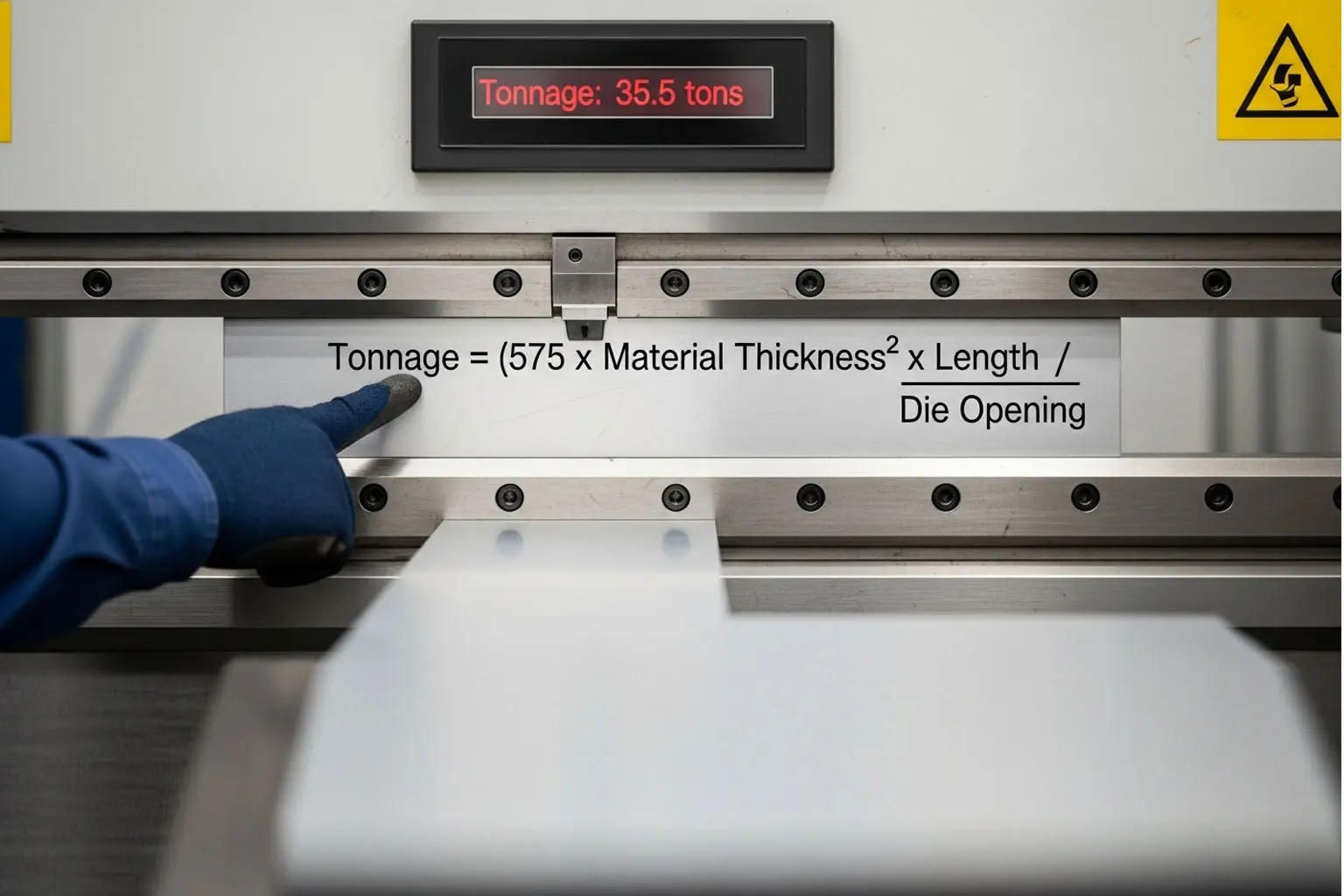
Ce guide explique la méthode de force de flexion la plus courante utilisée dans les magasins du monde entier—et comment l’appliquer en toute sécurité en production réelle.
Quel « tonnage »” Moyens sur un frein à pression
Tonnage est la force exercée par le frein à pression pour former la feuille entre la poinçonne et la puce en V. Elle s’exprime généralement comme:
-
Tonnes totales pour une longueur de courbure spécifique, ou
-
Tonalités par mètre / tonalité par pied comme référence d’urbanisme
Un bon choix de tonnage vous aide à choisir la bonne machine et le bon outillage, Et cela aide à éviter la surcharge.
Les entrées clés qui contrôlent la force de flexion
La plupart des formules de tonnage (et des calculatrices en ligne) dépendent de quatre variables de l’atelier:
-
Type de matériau / résistance
Acier doux, inox, et l’aluminium nécessite des niveaux de force différents en raison de la résistance (souvent modélisé à partir de facteurs de résistance à la traction). -
Épaisseur du matériau (t)
L’épaisseur a la plus grande influence. La force augmente rapidement à mesure que l’épaisseur augmente. -
Longueur de courbe (L)
Les courbes plus longues nécessitent plus de force car la charge est répartie le long de la ligne de courbure. -
Ouverture du dé V (V)
Une ouverture en V plus grande réduit le tonnage requis (Plus de levier), Mais cela augmente le rayon de courbure intérieur et peut affecter le contrôle de la bride.
La formule de magasin la plus utilisée: Tonnage de la maîtrise de l’air
Pour Maîtrise de l’air (La méthode la plus courante dans la fabrication moderne), Une approximation largement utilisée est:
Force (Tonnes) = (K × TS × L × t²) / V
Où:
-
L = longueur de courbe
-
t = épaisseur du matériau
-
V = Ouverture du dé V
-
TS = facteur de résistance du matériau (ou utiliser une résistance à la traction de référence)
-
K = une constante basée sur les unités et la méthode de courbe (Varie selon le graphique ou le système)
Parce que les constantes et les unités diffèrent selon les références (pouce/pied vs mm/m), De nombreux magasins utilisent un Tableau des tonnages ou un Calculatrice plutôt que de dériver manuellement les constantes. L’essentiel à retenir, c’est la relation:
-
La force augmente avec Longueur de courbe
-
La force augmente avec épaisseur carrée (t²)
-
La force diminue à mesure que Ouverture en V Augmentations
-
La force augmente avec Matériaux plus résistants (par exemple,, Acier inoxydable vs acier doux)
Choisir une ouverture en V pratique (Règle empirique)
Une règle de production courante consiste à choisir une ouverture en V autour 8× épaisseur (parfois 10× pour des matériaux plus épais ou lorsque la qualité de surface et la stabilité de la formation sont importantes). De nombreux calculateurs suggèrent automatiquement V en fonction de l’épaisseur.
Ce qui change quand V change?
-
V plus petit → rayon plus serré, Tonnage plus élevé, Risque accru de marquage
-
V plus grand → Tonnage inférieur, Rayon plus grand, Différences de précision potentielles si elles ne sont pas compensées
Facteurs matériels: Combien de force supplémentaire as-tu besoin?
Une méthode simple pour que de nombreux ateliers estiment l’impact sur les matériaux:
-
Acier doux = ligne de base
-
Inox ≈ nécessite une force nettement plus importante (souvent modélisé comme ~1,5× dans de nombreuses conventions de calculatrices)
-
Aluminium ≈ nécessite moins de force (souvent modélisé comme ~0,5× dans certaines conventions de calculatrices)
Votre facteur exact dépend de l’alliage et du trempage. Si vous passez de l’acier doux à l’acier haute résistance, ne réutilisez pas les mêmes hypothèses de tonnage—valider avec des courbes de test.
Manipulation de l’air vs Bottoming vs Création: La Force change beaucoup de choses
Maîtrise de l’air (Les plus courants):
Force la plus basse, angles flexibles avec contrôle de profondeur CNC.
Passage en bas:
Force plus élevée que la flexion de l’air car la feuille est pressée plus profondément dans l’angle de la puce.
Création:
Force maximale—Le matériau est « inventé » plastiquement” dans le dé, produisant un très faible rebond, Mais le tonnage peut être plusieurs fois plus flexible de l’air.
Si vous calculez le tonnage pour la flexion de l’air mais que vous utilisez un processus de bas/frappe, Vous pouvez trop surcharger la machine très rapidement.
Étape par étape: Comment calculer le tonnage en toute sécurité en production
Étape 1: Confirmez les bases du poste
-
Qualité des matériaux (Acier doux, Inox, aluminium)
-
Épaisseur
-
Longueur de bend pour chaque coup (pas seulement la longueur d’une partie)
Étape 2: Sélectionnez votre ouverture en V
Commencez par 8× épaisseur (ou votre standard), Puis ajustez si vous avez besoin d’un rayon ou d’une finition différente.
Étape 3: Estimez la force avec un tableau ou une calculatrice
Utilisez un calculateur fiable qui prend en compte Type de matériau, épaisseur, Longueur de courbe, et ouverture en V.
Étape 4: Ajoutez une marge de sécurité
Dans de vraies boutiques, La variation arrive:
-
Tolérance aux propriétés du matériau
-
Usure des outils
-
Variations de température et de lubrification
-
Différences de maniabilité des opérateurs
Une marge de planification prudente aide à éviter une charge limite.
Étape 5: Vérifiez les limites des machines et des outillages
-
Tonnage nominal de la machine et longueur de travail
-
Classification de tonnage de l’outillage (par mètre/pied)
-
Déflexion et capacité de couronnement du plateau/bélier (Longues courbes)
Exemple résolu (Conceptuel)
Disons que tu plies:
-
Acier doux
-
3 mm d’épaisseur
-
1,000 Longueur de courbure en mm
-
Ouverture en V ~ 24 mm (≈ 8× épaisseur)
Vous saisiriez ces valeurs dans votre tableau/calculatrice de tonnage pour obtenir la force totale requise. Si vous changez la même géométrie pour de l’inox, Le tonnage requis augmente considérablement (souvent modélisé comme ~1,5× dans de nombreuses conventions de calculatrices).
Le nombre exact de tonnage dépend de la constante/unités du calculateur, Mais la logique décisionnelle reste la même.
Erreurs courantes qui causent un tonnage erroné
-
Utilisant Longueur de la partie au lieu de Durée réelle de la flexion par coup
-
Oublier ça l’épaisseur est carrée dans le comportement de la force
-
Choisir un ouverture en V trop petite et le tonnage en hausse
-
Traiter l’acier inoxydable comme l’acier doux (ou mélanger des alliages sans validation)
-
Ignorer les classifications de tonnage des outillages et ne vérifier que la classification du frein à pression
Recommandation pratique pour les utilisateurs de JS RAGOS
Si vous souhaitez une planification fiable du tonnage à travers l’Amérique du Nord, Europe, et environnements de production en Asie, Standardisez votre processus:
-
Utiliser des constantes Règles d’ouverture en V par plage d’épaisseur
-
Maintenir un standard d’atelier Calculatrice de tonnage ou tableau
-
Documentez les facteurs de matériaux par familles d’alliages que vous pliez réellement
-
Validez les nouveaux supports avec de courts coupons de test avant les sorties complètes
Cette approche réduit les essais et erreurs, Améliore la répétabilité, et aide à protéger à la fois les machines et les outillages.