

Bases de la coupe par jet d’eau: Comment cela fonctionne et pourquoi c’est important
La coupe par jet d’eau est devenue l’une des technologies de traitement des matériaux les plus polyvalentes et précises dans la fabrication moderne. De la fabrication métallique et des composants aérospatiaux à la pierre, verre, Composites, et même la transformation alimentaire, Les jets d’eau offrent un Procédé de découpage à froid Capable de manipuler divers matériaux sans distorsion thermique.
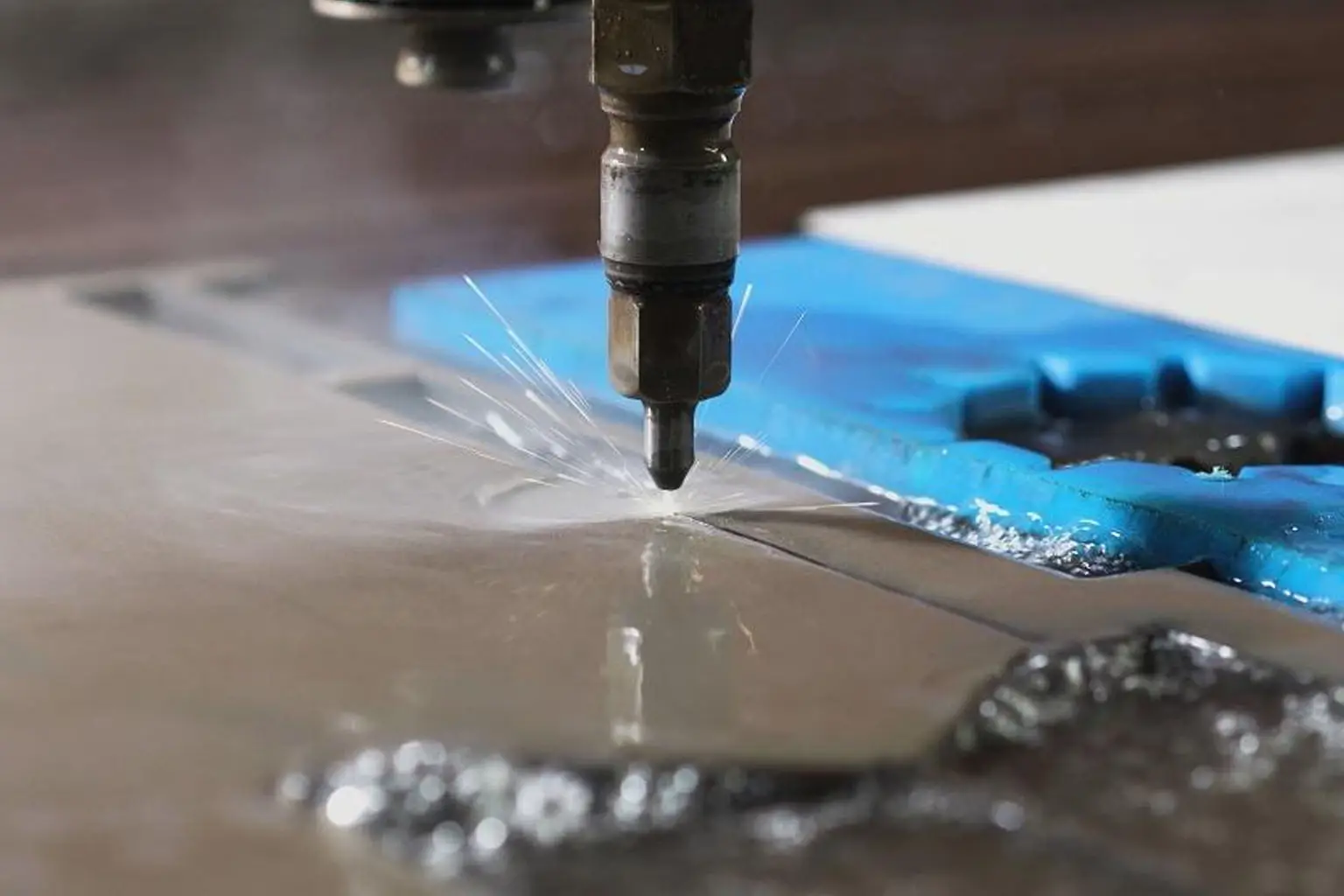
Dans ce guide, Nous expliquerons comment fonctionnent les jets d’eau, décomposer leurs composants de base, et explorer les avantages, Limitations, et applications concrètes pour les ateliers de fabrication à travers l’Amérique du Nord, Europe, et l’Asie.
Qu’est-ce que la coupe par jet d’eau?
La coupe par jet d’eau est un procédé qui utilise Eau ultra-haute pression, parfois combiné avec un abrasif comme le grenat, éroder le matériau le long d’un trajet contrôlé. Contrairement à la découpe plasma ou laser, La technologie du jet d’eau ne dépend pas de la chaleur pour couper. À la place, elle convertit la pression hydraulique en énergie cinétique pour créer un flux supersonique capable de trancher le métal, Pierre, et composites.
Parce que c’est un processus à froid, La coupe par jet d’eau ne crée pas de zone affectée par la chaleur (JUIN), ce qui signifie que les matériaux conservent leurs propriétés structurelles et chimiques après la coupe.
Composants principaux d’un système à jet d’eau
Un système de coupe par jet d’eau typique comprend plusieurs composants critiques:
1. Pompe haute pression
La pompe est le cœur du système. Il pressurise l’eau à des niveaux extrêmement élevés—souvent au-delà de 60,000 PSI, et dans certains systèmes, même plus haut.
Il existe deux types de pompes courants:
-
Pompes intensificatrices, qui utilisent la pression hydraulique pour amplifier la pression de l’eau
-
Pompes à entraînement direct, qui utilisent des ventouses mécaniques pour générer de la pression
2. Orifice et buse
Une fois pressurisé, L’eau s’écoule par un minuscule orifice en pierre précieuse ou en saphir. Cette petite ouverture convertit la pression en vitesse, produisant un mince, Jet extrêmement rapide.
Dans de nombreux systèmes, Le diamètre de l’orifice peut être plus petit qu’un trou d’épingle, permettant des trajectoires de coupe très précises.
3. Système de délivrance abrasive (Optionnel)
Pour la coupe de matériaux durs tels que l’acier, granit, ou verre, un abrasif fin (typiquement grenat) est introduit dans le jet d’eau.
L’abrasif augmente considérablement la capacité de coupe—par certaines explications, Le grenat ajouté multiplie considérablement la puissance de coupe par rapport à l’eau seule.
Dans des matériaux plus tendres comme la mousse, caoutchouc, ou certains plastiques, L’eau pure peut être suffisante sans abrasif.
4. Tête de coupe et réservoir de récupération
La tête de coupe focalise et dirige le jet avec précision. Après avoir traversé le matériau, Le jet entre dans un réservoir de récupération rempli d’eau qui absorbe son énergie restante.
Comment fonctionnent les jets d’eau: Étape par étape
La coupe par jet d’eau suit un principe physique simple mais puissant:
Étape 1 – Générer une pression extrême
Une pompe ultra-haute pression produit de l’eau à des dizaines de milliers de PSI.
Étape 2 – Convertir la pression en vitesse
Lorsque l’eau sort par un orifice microscopique, La pression se transforme en vitesse. Les jets d’eau industriels fonctionnent généralement dans des plages de 50,000 à 90,000 PSI.
Étape 3 – Introduire l’abrasif (Quand c’est nécessaire)
Pour les matériaux plus durs, Garnet est aspiré dans le courant-jet et accéléré à des vitesses très élevées.
Le résultat est un processus d’érosion à grande vitesse qui retire les matériaux de manière propre et précise.
Principaux avantages de la coupe par jet d’eau
1. Procédé de coupe à froid
Parce que les jets d’eau n’utilisent pas de chaleur, elles éliminent les zones affectées par la chaleur et la distorsion thermique.
Cela rend le jet d’eau idéal pour:
-
Métaux sensibles à la chaleur
-
Composites stratifiés
-
Matériaux trempés
-
Composants aérospatiaux
2. Haute précision
Les systèmes à jet d’eau sont capables de formes complexes, Détails fins, et des tolérances strictes.
Certains systèmes peuvent atteindre des largeurs de coupure aussi étroites que des fractions de millimètre selon l’application.
3. Polyvalence des matériaux
Les jets d’eau peuvent couper:
-
Acier et inox
-
Aluminium et alliages
-
Verre et pierre
-
Céramique
-
Matériaux composites
-
Plastiques et caoutchouc
Peu d’autres méthodes de coupe égalent cette polyvalence avec un seul outil.
4. Traitement secondaire réduit
Les coupes par jet d’eau produisent souvent des bords lisses nécessitant un post-traitement minimal.
Cela peut réduire le temps de finition et le gaspillage de matériaux.
Limitations courantes des jets d’eau
Malgré leurs forces, Les jets d’eau ont des compromis:
1. Coût de l’équipement
Les pompes haute pression et les systèmes abrasifs représentent un investissement en capital important.
2. Coûts d’exploitation
Consommation abrasive, Entretien des pompes, et la consommation d’énergie peut augmenter les dépenses opérationnelles.
3. Vitesse de coupe
Comparé au plasma ou au laser dans certaines plages d’épaisseur, La coupe par jet d’eau peut être plus lente pour les applications à fort volume.
4. Effilage de tranchant
Parce que le jet diverge légèrement en traversant le matériau, Les bords inférieurs peuvent légèrement varier du haut, sauf si des systèmes de compensation de conique sont utilisés.
Jet d’eau vs Autres technologies de coupe
Comparé à la découpe plasma, Le jet d’eau utilise de l’eau et de l’abrasif plutôt que des arcs électriques et des gaz comprimés.
Le plasma peut couper plus rapidement dans les applications d’acier épais, Mais le waterjet offre une préservation supérieure des matériaux et une qualité des tranchants dans de nombreux cas.
Fonctionnalités avancées du jet d’eau
Les systèmes modernes peuvent inclure:
-
Têtes de coupe à 5 axes pour le biseau et la découpe 3D
-
Systèmes de mouvement servo-pilotés pour la précision
-
Alimentateurs abrasifs automatiques
-
Systèmes anticollision pour la protection de la tête
Ces innovations élargissent les capacités des jets d’eau pour des environnements de fabrication complexes.
Où les jets d’eau sont utilisés
Les systèmes à jet d’eau sont largement utilisés dans:
-
Fabrication aérospatiale
-
Composants automobiles
-
Travail architectural, maçonnerie
-
Transformation alimentaire
-
Exploitation minière et forage
Leur capacité à couper presque n’importe quel matériau sans dommage thermique les rend précieuses dans les industries manufacturières mondiales.
Dernières réflexions
La coupe par jet d’eau combine une pression hydraulique extrême avec une ingénierie de précision pour offrir une polyvalence, Solution de découpe à froid. En convertissant la pression en vitesse et, en ajoutant, en ajoutant éventuellement de l’abrasif, Les jets d’eau peuvent couper des matériaux allant de la mousse à l’acier trempé.
Bien que les coûts d’équipement et d’exploitation puissent être plus élevés que pour certaines alternatives, Les avantages—précision, Polyvalence, et intégrité des matériaux—Faites des jets d’eau une option puissante pour les installations de fabrication modernes.