

Frein à pression CNC 200T pour inox: Guide de sélection et de configuration
L’acier inoxydable est notoirement difficile à former comparé à l’acier doux, caractérisée par sa Résistance élevée à la formation en traction et une tendance à riposter contre le bélier. Lors de la transition vers la production d’inox, De nombreuses équipes de fabrication sont surprises de constater que leur capacité standard de machine devient soudainement insuffisante.
Ce comportement découle des propriétés métallurgiques uniques du matériau, qui exigent une pression nettement plus élevée pour obtenir les mêmes résultats que l’acier au carbone. Dans de nombreux magasins professionnels, la machine de classe 200T est le point d’entrée pour un travail sérieux en acier inoxydable car elle fournit le tampon de force nécessaire pour gérer le Formation de zones de pointe de pression Inhérent à ce matériau.
Plier l’acier inoxydable nécessite une approche stratégique en raison de plusieurs défis spécifiques au matériau:
- Durcissement par travail de surface: L’inox devient plus dur et plus résistant à mesure qu’il se déforme, Augmentation de la charge en milieu de course.
- Récupération élastique: Haut Récupération de rendement force de reprise signifie que la pièce va "Ouvre" Significativement une fois la pression relâchée.
- Contrainte du rayon de flexion: L’inox est sujet à la fissure si Concentration de contrainte dans le rayon de flexion est trop serré pour la pente.
- Friction des outillages: La ténacité du matériau peut entraîner Gallage de surface, nécessitant des interfaces de puces spécialisées.
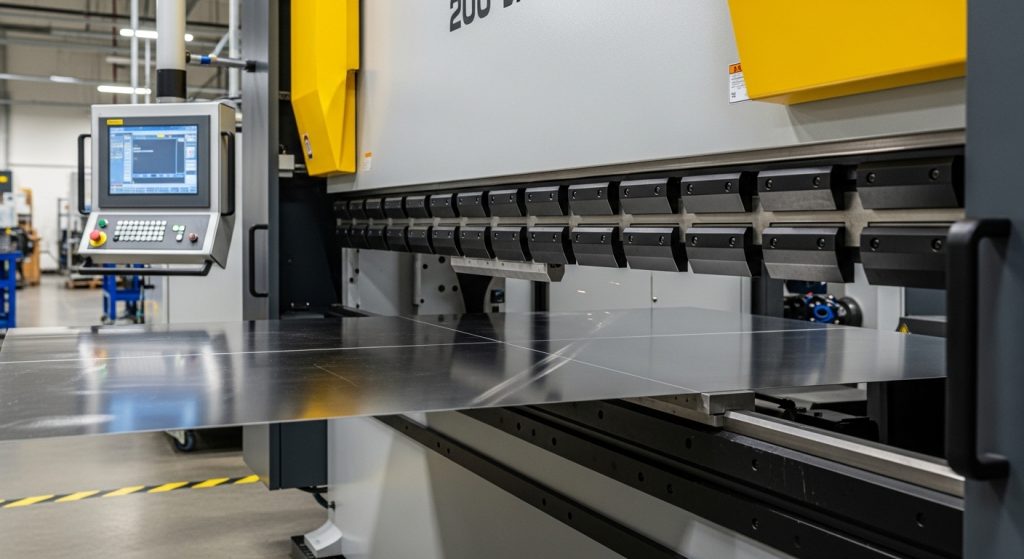
Pourquoi la flexion en acier inoxydable pousse les ateliers vers une capacité de freinage à pression CNC de 200 dents
Le principal moteur de l’exigence de 200T est le Augmentation de la résistance à la déformation plastique Présents dans les alliages inoxydables des séries 300 et 400. Alors que l’acier doux a un point d’élasticité prévisible, L’acier inoxydable possède un Comportement d’extension du plateau de rendement cela nécessite une force soutenue et croissante pour atteindre l’angle désiré. En général, L’acier inoxydable nécessite 50 % à 60 % de tonnage supplémentaire que l’acier doux de même épaisseur.
- Résistance à la traction: Une teneur plus élevée en chrome et en nickel augmente le Seuil d’absorption des contraintes du matériau, nécessitant plus de puissance brute pour initier la courbure.
- Mise à l’échelle de la charge: Une plaque d’acier doux de 4 mm pourrait facilement se plier sur une machine de 100 dents, Mais une feuille d’inox de 4 mm poussera cette même machine à sa limite absolue, risquant une surchauffe hydraulique ou une fatigue du châssis.
- Planification de la marge de sécurité: Fonctionner dans les 10 % supérieurs de la capacité d’une machine entraîne des angles incohérents. Une machine 200T permet un Courbe d’escalade de pression de formation qui reste dans la machine "Zone de confort," Garantir une précision répétable.
De vrais travaux en acier inoxydable où le frein à pression CNC de 200T devient le minimum
Dans la fabrication industrielle, certains secteurs dépendent de la plateforme 200T car la combinaison de l’épaisseur du matériau et de la longueur des pièces rend obsolètes les machines à tonnage plus faible.
- Panneaux d’équipements de qualité alimentaire: Les plans de travail épais en inox et les éviers de grande taille utilisés dans les cuisines commerciales nécessitent un nettoyage, Longues courbes en matériau 3mm+.
- Boîtiers de traitement chimique: Les récipients et coques fabriqués en inox 316L doivent être maintenus Tolérances de fabrication de l’hygiène industrielle, ce qui nécessite le steady, Contrôle haute pression d’un RAM de 200T.
- Enceintes structurelles en inox: Bornes électriques extérieures ou Tubage structurel résistant à la corrosion Utilisez souvent de l’inox de 5 mm pour assurer la longévité, exigeant un tonnage élevé même pour de courtes longueurs de bride.
Ces applications nécessitent plus que la simple force brute; ils exigent le Exigences pour le formage des équipements sanitaires où la courbure doit être lisse, Sans les micro-fractures qui peuvent abriter des bactéries ou provoquer la corrosion.
Comportement de reprise qui modifie le système de frein à pression en inox
L’un des aspects les plus frustrants de l’inox, c’est "mémoire." Le Décalage de récupération du module élastique En acier inoxydable est beaucoup plus prononcé qu’en acier au carbone, menant à une significative Effet de mémoire d’angle post-courbure.
- Cause: Une grande limite d’élasticité permet au matériau de conserver plus d’énergie élastique pendant la flexion.
- Effet: Une pièce courbée à 90° sous pression peut rebondir à 95° ou 100° une fois que le bélier se rétracte.
Boîte de règles pour l’installation en acier inoxydable:
Règle 1: Programmez toujours pour un Marge de compensation de la surflexion d’angle (souvent de 5° à 10°).
Règle 2: Utilisez une CNC avec "Calcul du rebond" pour ajuster le Déviation de décalage de l’axe neutre automatiquement.
Règle 3: Assurez-vous que l’ouverture du dé ($V$) est au moins 10 à 12 fois l’épaisseur du matériau pour réduire la pression et le rebond.
Comment la sélection des outillages change pour l’inox sur un frein à pression CNC 200T
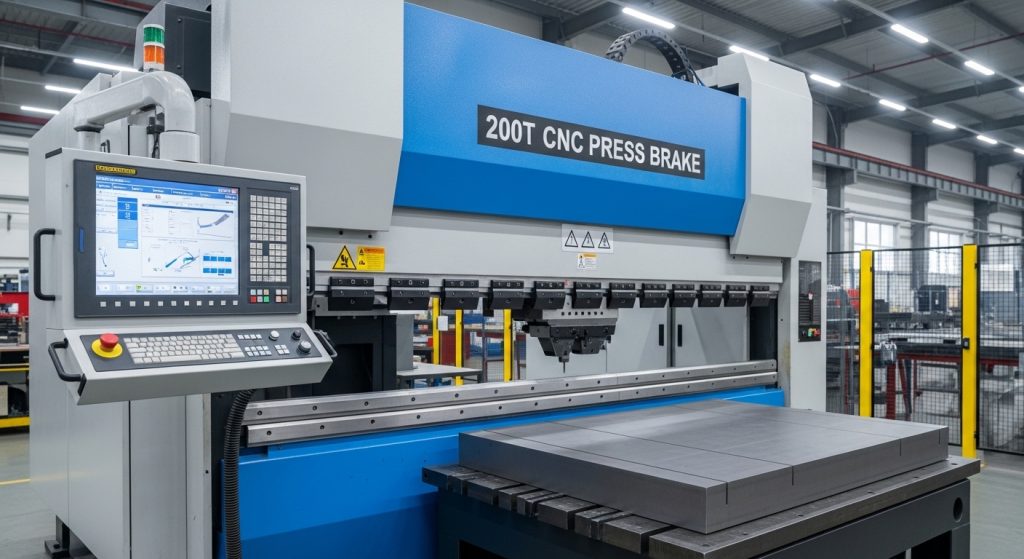
Utiliser des outillages standards pour l’inox sur une machine 200T est une recette pour le désastre. Le Concentration de pression sur l’épaule peut provoquer des déformations ou provoquer des déformations ou "Mark" la surface en acier inoxydable coûteuse.
- Outillages durcis: Les outils devraient avoir un Classification de résistance à l’usure à la dureté de l’outil de HRC 50 ou plus pour résister à la nature abrasive de l’acier inoxydable.
- Surface Protection: Pour éviter un Interface de prévention de la gallation en surface, De nombreux magasins utilisent "No-Mark" Film ou matrices synthétiques spécialisées pour empêcher le transfert de carbone de l’outil vers l’inox.
- Contrainte d’ouverture du die: On a 200T machine, le Zone de production de chaleur par friction de contact est intense. L’utilisation d’une ouverture en V plus grande répartit cette chaleur et cette pression, Protéger à la fois l’outil et la finition de la pièce.
Comment l’épaisseur de l’inox multiplie rapidement la demande de charge
La physique de la flexion dicte qu’à mesure que l’épaisseur augmente, La force requise croît de façon exponentielle, pas linéairement. Exactement Échelle de la résistance à la déformation des plaques c’est la raison pour laquelle une machine 200T est souvent le minimum requis pour les plaques de plus de 4 mm.
- Règle de l’épaisseur au carré: La force de flexion est proportionnelle au carré de l’épaisseur du matériau ($S^2$).
- Escalade de la Force: Doubler l’épaisseur de votre inox de 3 mm à 6 mm ne double pas la charge — cela la quadruple.
- Risque de surcharge: Sans courbe exponentielle de force de formation Calcul, Il est facile de déclencher accidentellement la soupape de décharge hydraulique d’une machine.
| Épaisseur de l’inox | Ouverture V-Die | Tonnage par mètre (Approximativement) |
| 3 mm | 24 mm | 35 tonnes |
| 4 mm | 32 mm | 48 tonnes |
| 5mm | 40 mm | 62 tonnes |
| 6 mm | 50 mm | 75 tonnes |
Erreurs de configuration qui provoquent des fissures en acier inoxydable ou des dommages aux outils
Le Résistance de l’écoulement des grains du matériau En acier inoxydable le rend sensible à la direction de la courbure et à la netteté des outils.
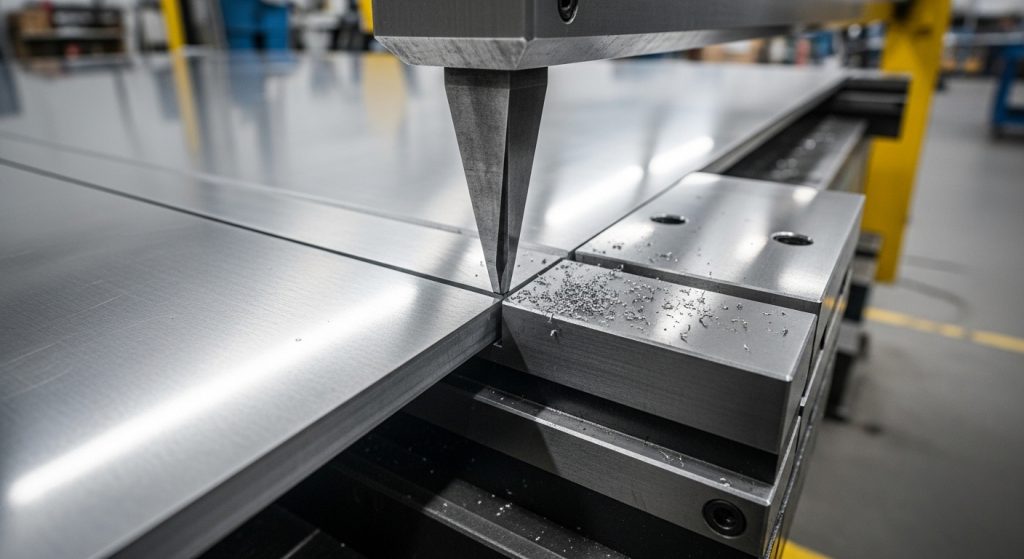
- Ouverture du mauvais dé: Utiliser une ouverture en V trop étroite crée un Défaillance localisée du pic de contrainte, ce qui peut casser un coup de poing ou fendre le matériau.
- Rayon de coup trop net: Si la pointe du poinçon est trop tranchante, Il agit comme un couteau, création Risque de rupture de la bordure des grains et des fissures visibles à l’extérieur du virage.
- Pas de tampon de tonnage: Faire fonctionner un chantier de 190 tonnes sur une machine de 200T ne laisse aucune place pour le Réponse à l’étape de durcissement des matériaux, Potentiellement calant la machine en plein virage.
Attention Zones de propagation de micro-fractures—si tu vois "Blanchiment" ou de petites lignes à l’extérieur du coude, Votre rayon de poinçon est trop petit ou votre matériau trop dur.
Lorsque le pliage en acier inoxydable nécessite une capacité supérieure à 200 t.
Alors qu’un frein à pression CNC de 200 dents est une véritable puissance, Il a ses limites, Surtout que le Escalade de la dureté de la plaque des augmentations dans les alliages spécialisés comme le Duplex ou les grades à haute teneur en nickel.
| Facteur | Restez avec le 200T | Passage au 300T - 600T |
| Épaisseur du matériau | Jusqu’à 6 mm (Longueur complète) | 8mm - 20 mm |
| Longueur de la courbe | 3200 mm à 4000 mm | Plus de 4000 mm ou Tandem |
| Type alliage | 304, 316, 430 | Duplex, Super Duplex, Inconel |
Si votre mix de production évolue vers Force de déformation en acier inoxydable de gros calibre Exigences, le châssis 200T deviendra finalement le goulot d’étranglement. Pour ces alliages à haut rendement, le Seuil élevé de résistance à la fluidité des alliages est tellement génial qu’une machine avec beaucoup plus "Réserve" le tonnage peut fournir l’écurie, résultats reproductibles requis pour la certification industrielle.
Lorsque les freins à pression en tandem remplacent les machines 200T uniques
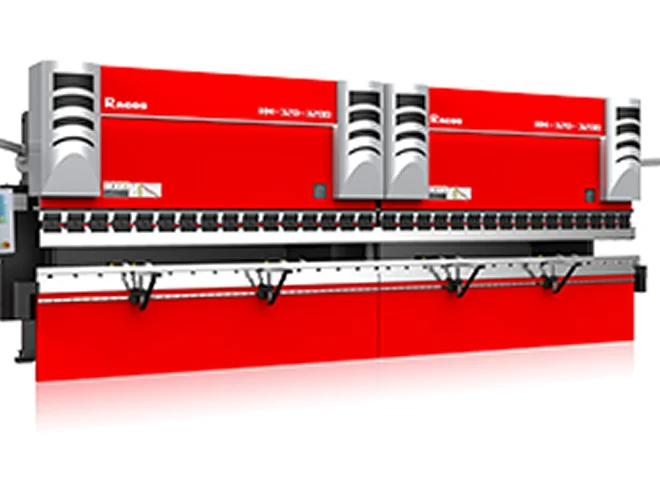
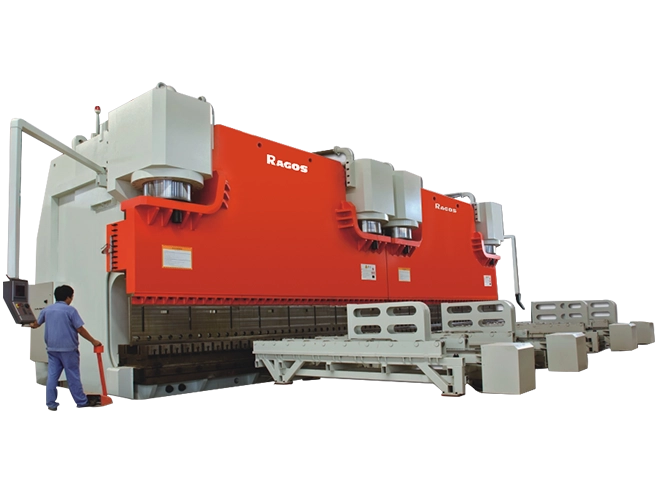
Pour les longs panneaux en inox qui nécessitent à la fois un tonnage élevé et une longueur extrême, Freins à pression en tandem proposer une solution unique. En utilisant Formage synchronisé multi-machines, Deux machines peuvent travailler ensemble pour partager la charge. Exactement Coordination de la double flexion du cadre est parfait pour les poteaux d’éclairage ou les longues sections architecturales qui nécessiteraient autrement un énorme, Machine unique construite sur mesure.
Comment la flexion d’une feuille en acier inoxydable de 10 mm modifie la planification des forces
Plier de l’acier inoxydable de 10 mm est une opération à enjeux élevés. Le Pression de formage en acier inoxydable d’épaisseur moyenne Required est énorme, Nécessitant souvent un Zone de transition de charge de formage en tôle Analyse. À cette épaisseur, le Amplification des contraintes du rayon de flexion devient un facteur majeur, et vous devez utiliser des dés en V nettement plus grands pour gérer le Réponse à l’étape de durcissement des matériaux. Découvrez la courbure en inox de 10 mm
Lorsque la plaque en inox passe à la plage 600T–3000T
Fabrication de plaques industrielles lourdes, comme pour les industries pétrolière et gazière ou maritime, nécessite un Frein à pression hydraulique 600T–3000T. Ces machines gèrent le Pression de déformation de la section épaisse en alliage nécessaire pour les réservoirs sous pression et les coques. Quand le Demande de formage en acier inoxydable de qualité navale est élevé, Ces machines robustes fournissent la charge de compression nécessaire pour façonner des alliages à haute résistance.
Choix de longueur 3200 vs 4000 lors de la pliée des panneaux en inox
La longueur d’un panneau en inox influence sa "raideur" pendant le virage. Notre Comparaison 3200mm vs 4000mm explique comment le Facteur de rigidité en acier inoxydable sur la longueur du panneau influences du Effet de rebond en inox à panneaux longs. Choisir la bonne longueur de lit est essentiel pour gérer la Décalage de précision de formage lié à l’envergure Sur toute la partie.
Lorsque les travaux en acier inoxydable nécessitent 4000 mm de longueur de frein à pression CNC plus le tonnage
Si votre travail implique des panneaux en inox de 4 mètres, Il faut à la fois l’espace pour le lit et l’électricité. Un Frein à pression CNC de 4000 mm assure Balance de formage à haut tonnage. Cette configuration est essentielle pour la maintenance Uniformité de la distribution des contraintes sur les arêtes longues, empêchant les extrémités du panneau de rebondir différemment du centre.